

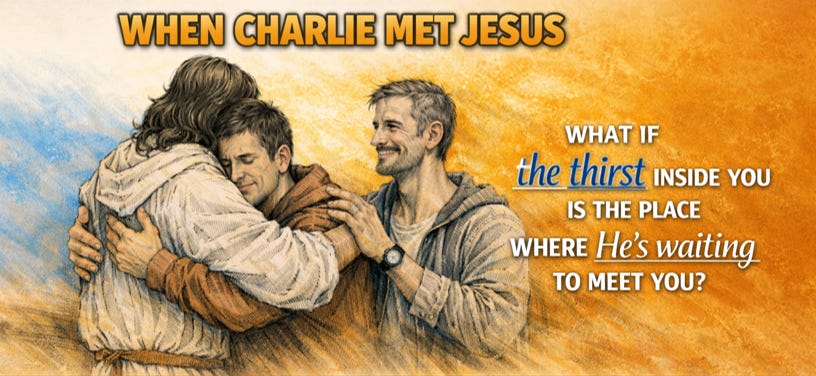
WHEN CHARLIE MET JESUS—CHAPTER 6
”THE CROSS JESUS CHOSE”
Chapter 6 opens with a simple but unsettling realization: Jesus didn’t just face the cross — He chose it. This chapter traces how that truth moved from an idea to something personal, as the brutality of the crucifixion collided with the deeper reason behind it: a love willing to stay, to suffer, and to stand in our place. It’s where the story of Jesus’ death stops feeling distant and begins to speak directly to the heart.

🎧 LISTEN TO TODAY’S AUDIO ▶ WATCH TODAY’S VIDEO
“The deepest measure of love is what someone is willing to suffer to save another.”
I couldn’t shake one sentence from my last conversation with Sheldon: “The Good Shepherd lays down His life for the sheep.”
The more I read, the more I realized Jesus wasn’t hinting at danger — He was pointing straight toward His own death. That unsettled me. If He could calm storms and raise the dead, why would He allow Himself to be killed?
A few evenings later we met on a bench overlooking the city. The sun was dropping behind the skyline, turning the buildings gold. I finally asked the question that had been bothering me. “Why did Jesus have to die?”
Sheldon didn’t flinch. “Because that’s why He came!”
I frowned. “But if He was innocent, why choose that?”
He reminded me of Jesus’ words about the Good Shepherd.
“He said He ‘lays down’ His life. Not that it would be taken from Him. Long before His arrest, He told His followers He was going to Jerusalem to suffer and die. He wasn’t trapped. He chose it.”
That idea rattled me. Nobody chooses torture. Nobody walks toward a cross. “Why would He do that?” I asked quietly.
Sheldon took a breath. “Because our deepest problem isn’t lack of purpose or happiness. It’s the separation from our Creator caused by our sin.”
I didn’t like the word, but I couldn’t deny the reality behind it. I knew the lies I’d told, the selfish choices, the regrets I carried. Something in me was bent, and no amount of self‑improvement had ever straightened it.
“God is perfectly good and just,” Sheldon continued. “He can’t ignore evil. Justice demands that sin be dealt with. But He also loves the people who committed it. The cross is where justice and mercy meet. Jesus stepped into our place.”
That sentence stayed with me long after we said goodbye.
That night I opened the Gospel of John and read the crucifixion account slowly. Jesus was betrayed by one of His own. Arrested in the dark. Dragged before leaders who twisted His words. Soldiers mocked Him, blindfolded Him, struck Him, spit on Him.
Then came the scourging. I had always imagined it as a symbolic punishment. It wasn’t. Victims were tied to a post and whipped with leather straps embedded with bone and metal. The lashes tore through skin and muscle. Many before Him had died just from this lashing alone.
Jesus didn’t.
The soldiers jammed a crown of thorns onto His head, dressed Him in a robe, bowed in fake worship, then beat Him again. Finally they forced Him to carry the crossbeam through the streets until He collapsed. At the execution site, they nailed Him to the wood.
Hours passed. Blood loss, exhaustion, and suffocation slowly crushed the life out of Him. When His work was complete, He said, “It is finished,” and gave up His spirit.
What struck me most was what didn’t happen. The man who calmed storms didn’t calm this one. The man who raised Lazarus didn’t save Himself. The man who claimed authority over death submitted Himself to death. He stayed.
The next afternoon I met Sheldon again.
When he asked what stood out, I told him exactly that. “He stayed.”
Sheldon nodded, almost tenderly. “That’s when the cross began making sense to me too.”
“How?” I asked.
“Because love stays. Parents stay beside hospital beds. Firefighters run into burning buildings. Soldiers step into danger for others. Real love willingly bears a cost. Jesus saw exactly what was coming — and stayed.”
Something tightened in my chest. I had spent days reading about Jesus’ miracles and authority. But the cross revealed something different. Not sentimental love. Costly love. Love that suffers for someone else.
“Sheldon… what if it’s true?”
“If it is,” he said gently, “then the cross means God knows everything about you and loves you anyway. Jesus didn’t just die for us in the sense of helping us. He died instead of us. He took the judgment our sins deserved so we could be forgiven and brought back to God. And the Father accepted His sacrifice as payment in full.”
Then he looked me in the eye. “He died for your sins, Charlie.”
I didn’t know what to say. One of my deepest fears wasn’t that God didn’t exist — it was that He did, and would reject me if He truly knew me. Yet the cross seemed to say the opposite. Jesus saw humanity at its worst and came anyway. He saw betrayal, hatred, violence, and sin — and stayed anyway.
As we stood to leave, Sheldon smiled. “Next time we’ll talk about what happened three days later.”
“Wait!? There’s more after this?” I asked.
“Oh yes. Read the last chapters of John. Then we’ll talk.”
Walking to my car, the cross no longer felt like a religious symbol or a piece of church décor. It felt personal. And for the first time, I wondered whether Jesus had done all of that for people like me.
“But God demonstrates His own love toward us, in that while we were still sinners, Christ died for us.”
—Romans 5:8—