

— 2 —
The Flood of Noah
(Genesis 6–9)
The story of Noah’s Flood is one of those passages everyone thinks they know—until they stop and actually read it. Then the questions start coming. Could water really cover the entire earth? Could an Ark carry every kind of animal? Could one family survive while the rest of humanity perished? Those are fair questions. They’re exactly the questions we’re going to wrestle with in this chapter.
In fact, they’re exactly the kinds of questions we should ask if we’re serious about understanding what the Bible actually claims.
Genesis doesn’t present the Flood as a legend or a moral fable. It presents it as history. So let’s look honestly at what happened, why it seems impossible, and why thoughtful Christ-followers still believe it.
What the Bible Says Happened
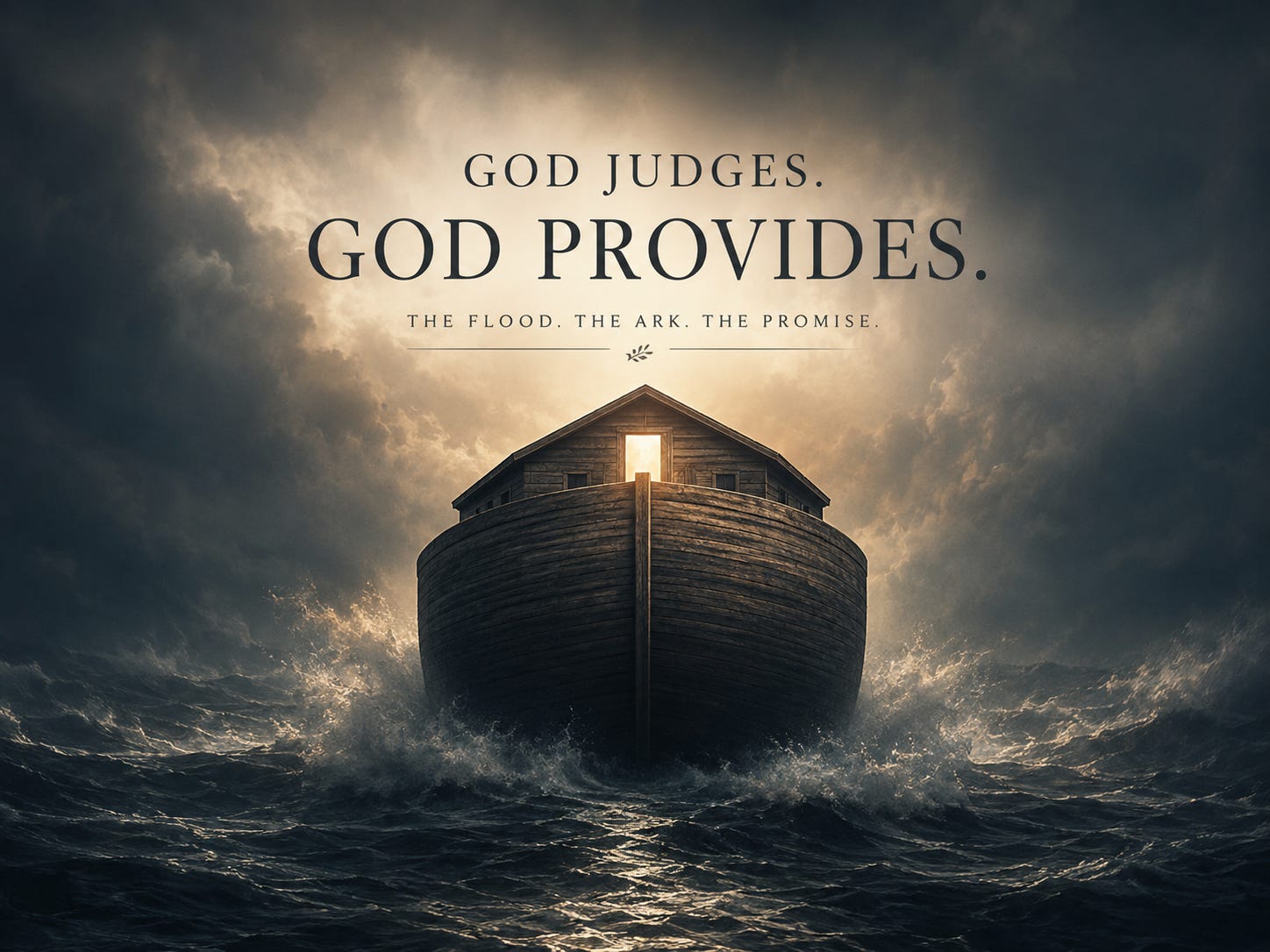
Genesis 6–9 tells us that humanity had become profoundly corrupt. Violence filled the earth, and every inclination of people’s hearts had become increasingly evil. God announced that judgment was coming, but He also provided a way of escape.
He instructed Noah to build a massive wooden vessel (“Ark”) with very specific dimensions. Noah obeyed, despite having every reason to think the project looked absurd to everyone around him.
Then Scripture tells us something remArkable:
“All the fountains of the great deep were broken up, and the windows of heaven were opened.”
Water came from below and above. Rain fell for forty days and forty nights. The floodwaters rose until “all the high hills under the whole heaven were covered.”
Everything outside the Ark died.
After many months, the waters gradually receded. The Ark came to rest on the mountains of Ararat, and Noah’s family stepped into a world that had been forever changed.
It’s an extraordinary account. And if you’re thinking, That couldn’t happen naturally, I agree.
That’s exactly why the Bible calls it a miracle.
Why This Seems Implausible
Let’s acknowledge the obvious problems.
Where did enough water come from to cover the earth?
How could rain alone flood the entire planet?
Could a wooden vessel that size really survive such a catastrophe?
How could Noah care for so many animals for over a year?
And wouldn’t a global flood leave unmistakable geological evidence?
Those are thoughtful questions. They deserve thoughtful answers—not dismissive ones.
The important thing to remember is that Genesis never describes the Flood as an unusually large “natural” disaster. It describes God intervening directly in His creation.
The event was supernatural from beginning to end.
What May Have Happened Scientifically
Notice that Genesis doesn’t simply say it rained.
It says, “the fountains of the great deep were broken up.”
That language suggests massive geological upheaval unlike anything we observe today. God may have ruptured the earth’s crust, released enormous underground reservoirs, or dramatically reshaped the planet itself. Whatever the precise mechanism, this was far more than an unusually rainy season.
Likewise, “the windows of heaven” describes a supernatural release of water from above. Scripture isn’t inviting us to explain the Flood through ordinary weather patterns. It is describing God using the forces of creation in extraordinary ways.
The Ark itself also deserves a closer look. Its proportions closely resemble those used in modern cargo ships—not designed for speed, but for stability. More importantly, Noah’s survival ultimately depended less on his shipbuilding skills than on God’s preservation.
The same is true for the animals. Genesis says they came to Noah. That alone required God’s intervention. Their care, survival, and eventual repopulation of the earth all point to God’s ongoing providence.
In other words, the Flood was not “nature” temporarily behaving strangely.
It was the Creator exercising authority over the world He made.
Why Believing This Is Reasonable
People sometimes ask, “How could a global flood happen?”
The better question is, “Could the Creator of the earth reshape His own creation?”
If God spoke the universe into existence, reshaping the earth would hardly be beyond His ability.
Again, the difficulty of any task is measured by the One doing the work.
If there is no Creator, then Noah’s Flood is impossible.
But if there is an all-powerful Creator who rules over oceans, mountains, weather, and gravity, then a global flood is not difficult—it is simply another demonstration of His authority.
Interestingly, there are also clues outside the Bible that make the account worth taking seriously. Flood traditions appear in cultures around the world. Marine fossils are found high in mountain ranges. Large sedimentary formations often point to rapid deposition rather than slow accumulation. None of these facts proves Noah’s Flood by themselves, but together they remind us that Earth’s history may have been far more catastrophic than many people assume.
Ultimately, belief in the Flood does not rest on geology.
It rests on the God who governs geology.
What This Miracle Reveals About God
The Flood isn’t primarily a story about water.
It’s a story about God’s holiness.
Modern culture often prefers to think of God as endlessly tolerant. Genesis presents a God who is incredibly patient—but who also takes human sin seriously.
For generations, God warned before He judged. Noah preached while building the Ark. The door remained open until the very last moment.
Judgment was never God’s first response.
But neither was it absent.
At the same time, the Flood reveals God’s remArkable mercy.
While judgment fell upon the world, God provided an Ark.
That Ark became a place of refuge for everyone willing to trust His word.
Throughout Scripture we see this same pattern repeated. God warns before He judges. He provides a way of escape before judgment falls. Ultimately, that refuge is found in Jesus Christ.
The Ark wasn’t simply a boat.
It was a picture of salvation.
Closing Thought
Whenever I read the Flood account, I don’t find myself thinking first about rainfall, geology, or shipbuilding.
I think about a God who is both perfectly holy and perfectly merciful.
A God who hates evil enough to judge it—but loves people enough to provide a way of rescue before judgment comes.
You may still have unanswered questions. I understand that. But I hope you can see why thoughtful Christ-followers continue to believe Noah’s Flood wasn’t an ancient fairy tale.
It was a real act of divine judgment, a real demonstration of divine mercy, and a powerful reminder that the God who judges sin is also the God who provides salvation.
And if He provided an ark for Noah’s generation, maybe He’s still inviting you and me to step into the shelter of His protection in ours.