

When I talk with people about the Bible’s most difficult miracles, Genesis 1 almost always comes up first.
God created everything in six days? Light, oceans, dry land, plants, stars, animals, and human beings—all brought into existence by divine command?
I understand why that feels like a massive intellectual hurdle. We live in a world that explains origins in terms of billions of years, gradual development, and natural processes. Genesis gives us something entirely different. It says God spoke—and creation appeared.
“So the evening and the morning were the first day.”
That sentence does not sound tentative. It does not read like a scientific theory waiting to be tested. It reads like a declaration.
If we are going to examine the Bible’s miracles honestly, we might as well begin with the biggest one.
What the Bible Says Happened
Genesis 1 presents creation as a sequence of divine commands.
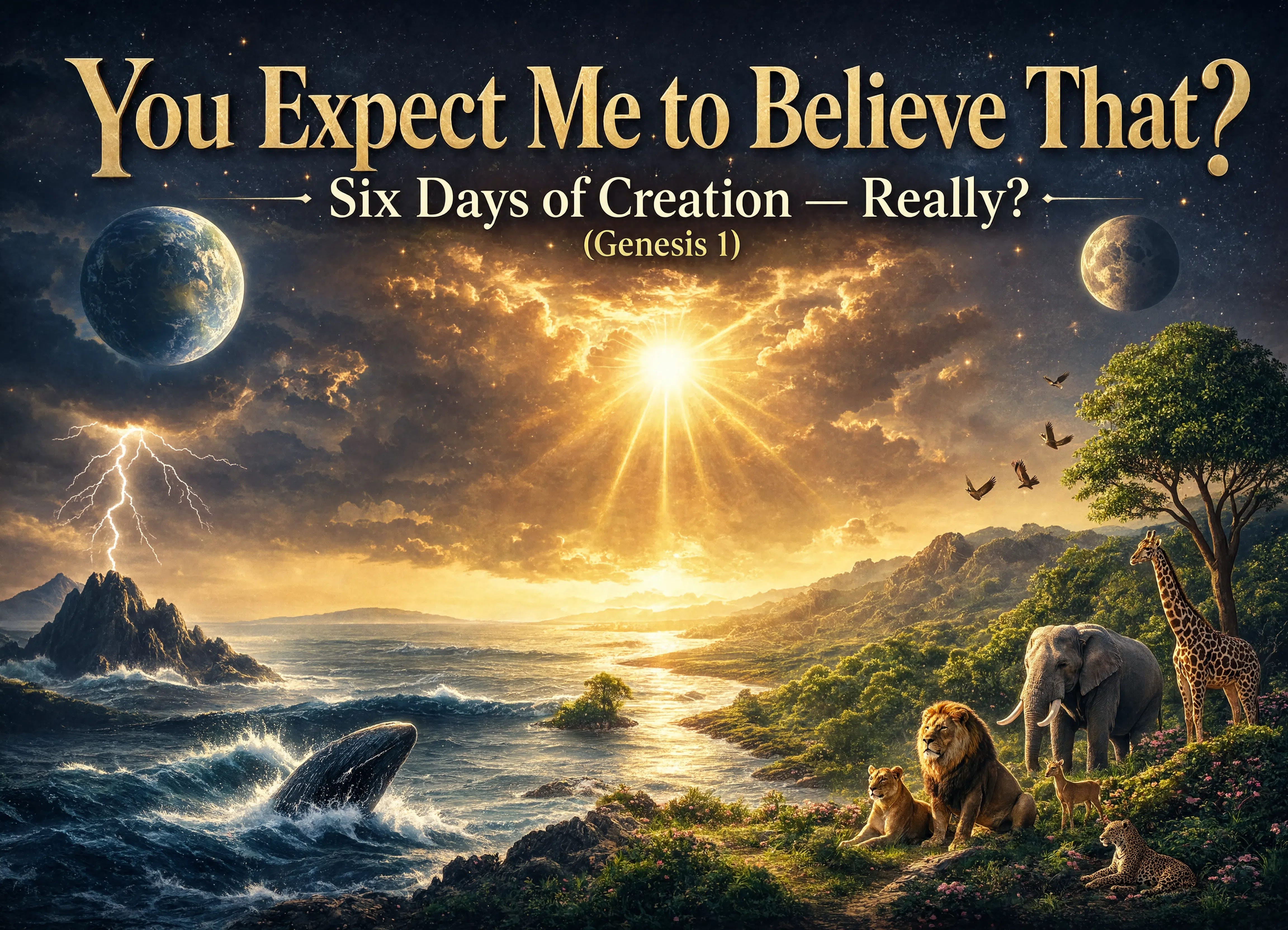
God says, “Let there be light,” and light appears. He separates the waters, brings dry land into view, fills the earth with vegetation, places the sun, moon, and stars in the heavens, creates animals, and finally forms human beings in His own image.
The repeated pattern is unmistakable:
God speaks.
Creation responds.
God declares it good.
The passage does not describe God experimenting, struggling, or waiting for nature to cooperate. It describes immediate, intentional creation.
Light appears before the sun. Plants exist before the sun is placed in the sky. Stars—more than we can count—are summarized with the almost casual statement, “He made the stars also.”
Adam is not created as an infant. Trees are not planted as seeds. Animals do not begin as single-celled organisms. Everything appears mature, functional, and ready to fulfill its purpose.
If we take the passage at face value—and I do—Genesis 1 describes six actual days of supernatural creation.
Why This Seems Impossible
Let’s be honest about the difficulty.
Nothing in Genesis 1 fits comfortably inside the ordinary processes we observe today.
Light normally comes from an energy source. Genesis says light existed before the sun and stars.
Plants require sunlight, water, soil, growth, and time. Genesis says vegetation appeared already producing seed and fruit.
Stars form, according to modern scientific models, through enormous processes involving gas, gravity, pressure, and time. Genesis says God made them by command.
Human beings develop through reproduction, genetics, pregnancy, and birth. Genesis says Adam was formed from the dust and Eve was fashioned from Adam’s side.
Naturally speaking, these things cannot happen.
But Genesis is not describing what nature can do by itself. It is describing what God did to bring nature into existence.
That distinction matters.
What May Have Happened Scientifically
Sometimes people say, “Genesis contradicts science.” But science studies the behavior of the natural world as it now operates. Creation describes the beginning of that world.
Before Genesis 1:1, there was no universe for scientists to observe. There was no matter, energy, biology, geology, or astronomy. The laws we study were not floating around waiting for God to obey them. They came into existence with the universe.
When God created light, He was creating the physical reality that light would later operate within. When He created plants, animals, and people, He was not speeding up ordinary development. He was creating complete living systems.
That may sound strange, but it is not incoherent.
Think about Adam. If you had seen him five minutes after his creation, you might have assumed he had lived for years. He had adult height, adult bones, adult muscles, and an adult brain. Yet he had been alive only moments.
His apparent age was not the result of elapsed time. It was the result of design and distinct creative actions.
The same principle could apply to the rest of creation. God could create trees with rings, stars whose light was already visible, mountains already formed, and a universe fully prepared to sustain life.
Creation would therefore appear mature from its first moment because God created it to function immediately.
A programmer does something similar when launching a digital world. The world does not have to begin as an empty screen and slowly evolve. Mountains, rivers, trees, weather systems, and characters can all appear when the program begins because they were written into the starting conditions.
Genesis describes God establishing the starting conditions of reality itself.
Why Believing This Is Reasonable
The real issue is not whether six-day creation can occur naturally.
It cannot.
The real question is whether an all-powerful Creator could do it.
Once that question is asked, the scale of the miracle changes.
If God can create matter from nothing, creating a mature tree is not difficult. If He can design DNA, forming Adam is not complicated. If He can create space, time, gravity, and energy, making stars is hardly a problem.
The difficulty of any task is measured by the one doing the work.
A child cannot build a skyscraper. A trained construction team can. A human being cannot speak a universe into existence. An Almighty God can.
Some people object that scientific evidence points to an ancient universe. Christians disagree about how that evidence should be interpreted. But even the appearance of age would not disprove supernatural creation. A world created fully mature would naturally contain features that ordinarily result from time.
Trying to measure creation only by present-day natural processes assumes that no Creator was involved. But Genesis is making the opposite claim. It tells us that the beginning of the universe was unlike every ordinary event that followed because God was personally bringing it into existence.
Believing Genesis 1 is not believing that nature created itself in six days.
It is believing that God did.
What This Miracle Reveals About God
Genesis 1 does more than tell us how the universe began. It tells us who God is.
He is the Creator.
Before the Bible reveals Him as Shepherd, Savior, Judge, Father, or King, it reveals Him as the One from whom everything came.
That means the universe belongs to Him. The stars belong to Him. The earth belongs to Him. Our bodies, abilities, possessions, and lives belong to Him.
We are not accidents living in a meaningless universe. We are creatures made deliberately by a personal God.
Genesis also reveals that God creates through His word. He does not wrestle creation into submission. He speaks with absolute authority, and reality obeys.
He creates order from emptiness, beauty from dArkness, and life where no life existed before.
And when God creates human beings, He does something unique. He makes them in His own image. Human life therefore has dignity, purpose, and value—not because society grants it, but because God designed it.
Creation is not merely evidence that God is powerful. It is evidence that He has the right to rule what He made.
Closing Thought
Genesis 1 does not begin by arguing for God’s existence. It begins by announcing Him:
“In the beginning God created the heavens and the earth.”
If God does not exist, creation as Genesis describes it is impossible.
But if God does exist, six-day creation is not an embarrassment. It is exactly the kind of beginning we should expect from an Almighty Creator.
You may not be ready to accept every detail. I understand that. But I hope you can see that the question is larger than the age of rocks or the formation of stars.
The question is whether the universe is all there is—or whether it exists because Someone spoke it into being.
And if the God of Genesis truly created everything, then every miracle that follows suddenly becomes much easier to believe.