

— 3 —
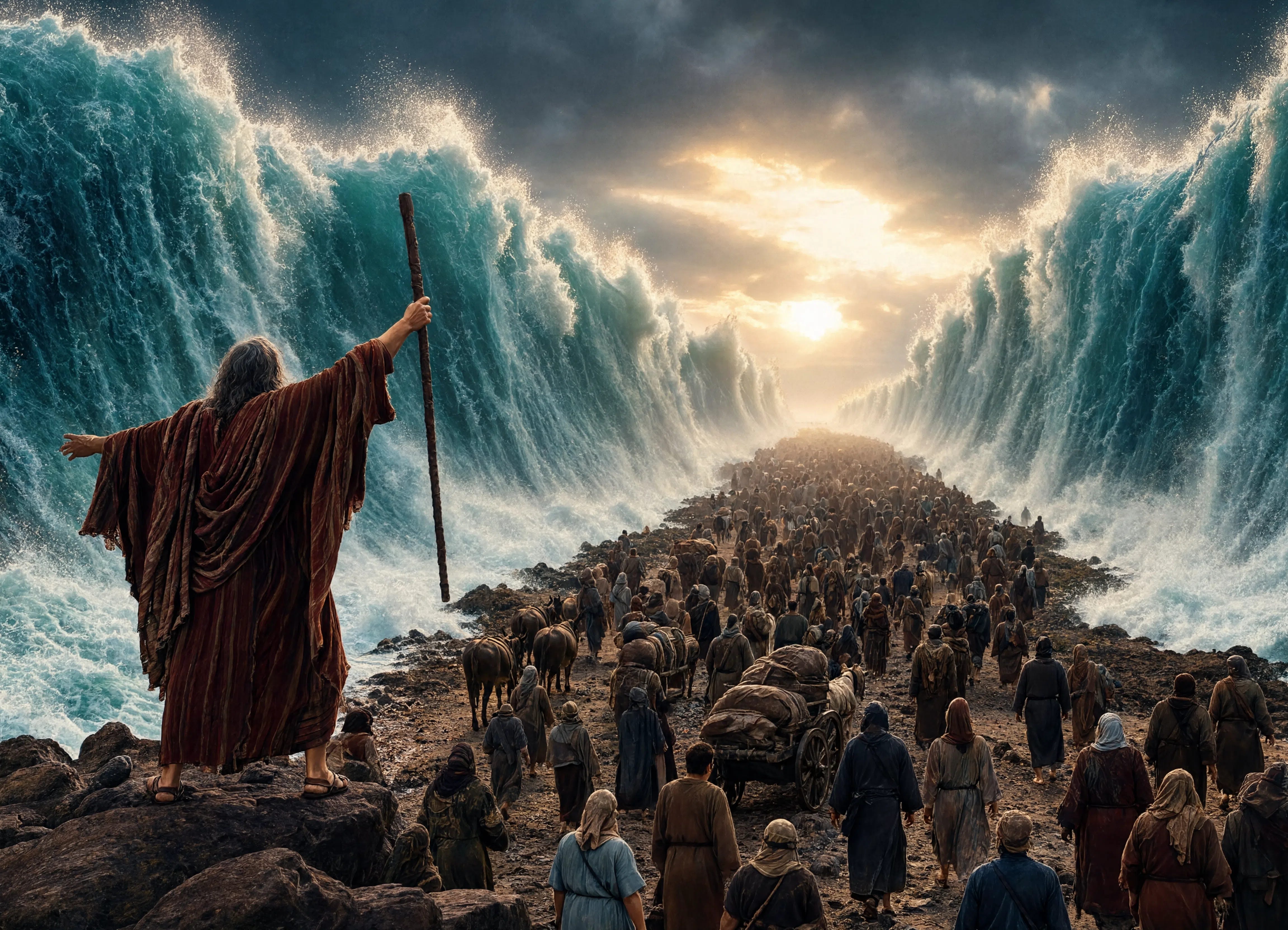
Parting of the Red Sea
(Exodus 14)
Imagine standing on the shoreline with nowhere to go.
Behind you is the most powerful army on earth. In front of you is a vast body of water. On either side are mountains. Every escape route has disappeared.
That’s where the Israelites found themselves in Exodus 14.
From a human perspective, they were trapped. From God’s perspective, they were exactly where He wanted them.
Then something happened that has captured people’s imagination for more than three thousand years.
The sea opened right up!
Not just enough to get their feet wet. Not just enough to wade across. Scripture says the waters stood like walls while an entire nation crossed on dry ground.
If you’ve ever wondered, Did that really happen? you’re asking the right question.
Let’s take an honest look at the account.
What the Bible Says Happened
After four hundred years of slavery, God delivered Israel from Egypt through a series of miraculous plagues. Pharaoh finally let them go, only to change his mind and pursue them with his army.
As Israel camped beside the Red Sea, panic spread through the people. They could see Pharaoh’s chariots approaching, and there was no obvious way to escape.
God told Moses to stretch out his hand over the sea.
Then Exodus tells us:
“The LORD caused the sea to go back by a strong east wind all that night... and the waters were divided.”
The Israelites crossed on dry ground while the waters stood “as a wall” on both sides.
When Pharaoh’s army followed, the waters returned, destroying the Egyptian forces.
The Bible presents this as a literal historical event—not a legend, not a symbol, and not an exaggerated story.
Why This Seems Scientifically Implausible
Let’s acknowledge the obvious.
Water doesn’t behave this way.
Gravity causes it to flow downhill. Pressure causes it to spread. Even powerful winds can create waves or temporarily push shallow water aside, but they cannot produce towering walls of water with a dry path between them.
Even if wind displaced the water, the seabed would still be deep mud—not firm enough for hundreds of thousands of people, along with livestock, to cross.
Everything about the account stretches beyond what natural processes can explain.
That’s exactly why it has been debated for centuries.
Some have suggested a marsh, an unusually low tide, or an exceptionally strong wind.
But those explanations don’t fit the details Scripture gives us. A shallow marsh would not drown Pharaoh’s army. Nor would it produce walls of water or a dry seabed.
The Bible is describing something far greater than an extraordinary weather event.
It is describing divine intervention.
What God Actually Did
One detail is easy to miss.
Exodus says God used a “strong east wind.”
Some readers assume the wind was the explanation.
The text says the opposite.
The wind was the instrument.
God was the cause.
Throughout Scripture, God often uses ordinary things to accomplish extraordinary purposes. Moses used a staff. David used a sling. Jesus used mud to heal a blind man.
The power was never in the instrument.
It was always in God.
However God accomplished the crossing, several things had to occur simultaneously.
The waters had to separate and remain suspended.
The seabed had to become immediately dry and stable.
The passage had to remain open long enough for an entire nation to cross.
Then, at precisely the right moment, the waters returned upon the Egyptian army.
Whether God directly suspended the normal behavior of water, controlled every molecule, or worked in ways beyond our understanding, the point remains the same:
Nature obeyed its Creator.
Why Believing This Is Reasonable
The real question isn’t whether oceans normally divide.
They don’t.
The real question is whether the God who created the oceans has authority over them.
If God brought the universe into existence, then commanding the sea is hardly beyond His ability.
The difficulty of any task is measured by the One doing the work.
Throughout the Bible, the sea often represents chaos, danger, and forces beyond human control.
Again and again, God demonstrates that what terrifies us obeys Him.
He tells the sea where to stop.
He calms storms.
He walks on water.
The Red Sea miracle is entirely consistent with the God Scripture reveals.
Some archaeological and historical questions surrounding the Exodus remain debated, including the precise location of the crossing. But the central issue isn’t geography.
It’s theology.
Did the Creator intervene to rescue His people?
If He exists, the answer is entirely reasonable.
What This Miracle Reveals About God
The Red Sea isn’t primarily about water.
It’s about redemption.
Israel could not rescue itself.
No military strategy would save them. No negotiation with Pharaoh would free them. They were completely dependent upon God.
And that’s exactly where God wanted them.
Sometimes God leads His people into situations where every human solution disappears so they can discover that He is the solution.
The Red Sea also reveals that God is both Deliverer and Judge.
The same waters that became a path of salvation for Israel became an instrument of judgment for Egypt.
Throughout Scripture, God’s acts of salvation and judgment often stand side by side.
Most importantly, the crossing points beyond itself.
The New Testament repeatedly describes salvation as God delivering His people out of slavery—not slavery to Pharaoh, but slavery to sin.
The Exodus became the defining picture of redemption in the Old Testament because it foreshadowed an even greater deliverance accomplished through Jesus Christ.
The God who made a way through the sea is still the God who makes a way where none seems possible.
Closing Thought
Whenever I read Exodus 14, I’m reminded that God rarely removes every obstacle before asking us to trust Him.
The sea didn’t open while Israel was still in Egypt.
It opened when there was nowhere else to go.
That’s often how God works.
He waits until the situation looks impossible—not because He enjoys watching us struggle, but because He wants us to discover that His power is greater than our limitations.
You may still have questions about exactly how the sea divided. That’s understandable.
But perhaps the greater question is this:
What kind of God is able to make a way where there isn’t one?
Exodus answers with confidence.
He is the sovereign Lord of heaven and earth, and nothing—not even the sea itself—can stand in the way of accomplishing His purposes.