

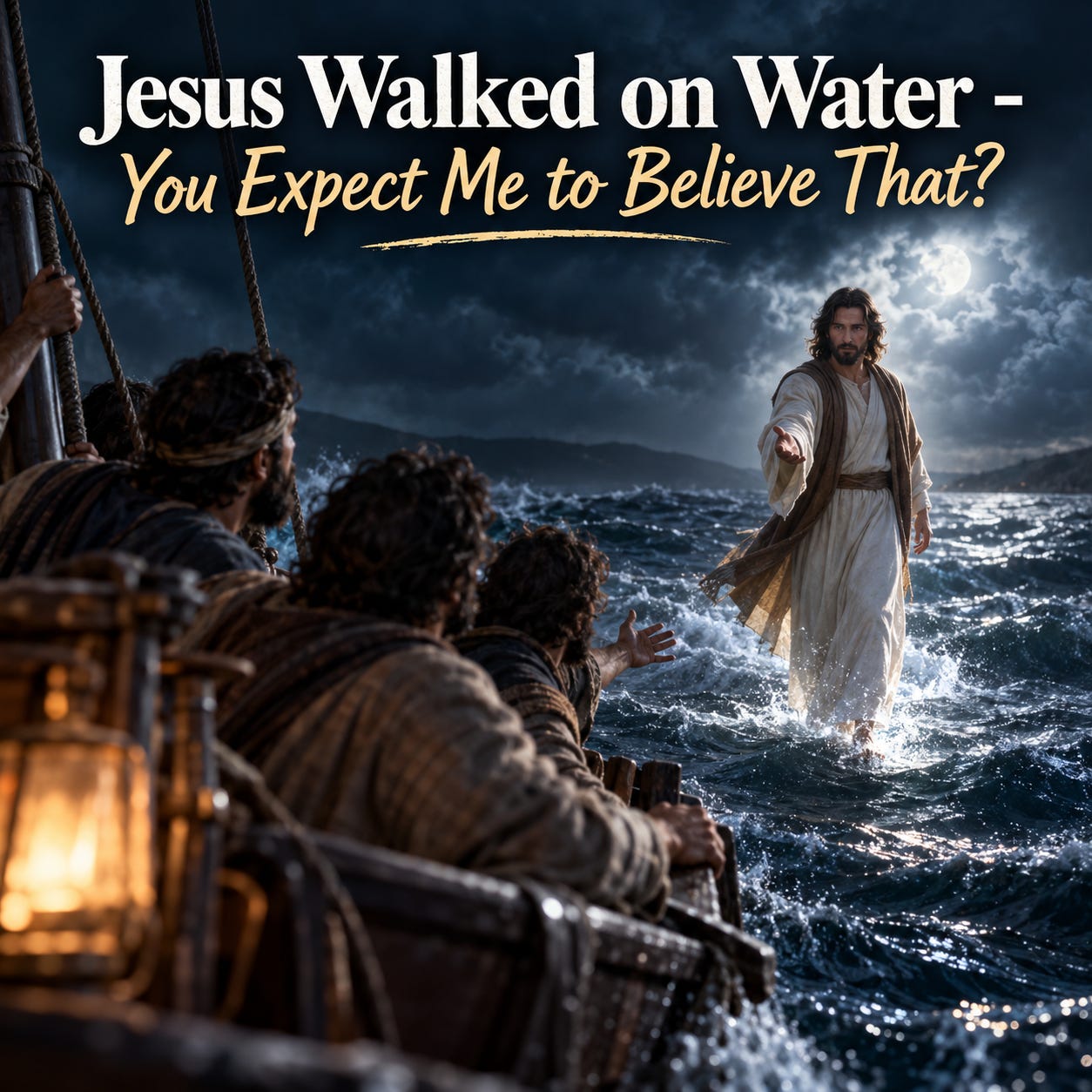
Jesus Walks on Water
(Matthew 14:22–33)
If someone asked you to name the most recognizable miracles of Jesus, walking on water would almost certainly make the list.
It’s one of those events that even people with very little knowledge of the Bible have heard about. And it’s also one of the easiest to dismiss. After all, everyone knows people can’t walk on water.
Exactly.
The Bible never suggests they can.
The whole point of the miracle is that Jesus did something no human being could ever do. So instead of asking whether people can naturally walk on water, let’s ask the more important question: What does this miracle tell us about Jesus?
What the Bible Says Happened
The miracle took place shortly after Jesus miraculously fed more than five thousand people with a few loaves of bread and two fish.
He sent His disciples ahead by boat while He went into the hills to pray. Hours later, sometime before dawn, the disciples were battling strong winds and rough seas on the Sea of Galilee.
Then they saw something they never expected .Jesus was walking toward them on top of the water.
Their first reaction wasn’t excitement. It was terror. They assumed they were seeing a ghost. Jesus immediately called out, “Be of good cheer! It is I; do not be afraid.”
Peter answered, “Lord, if it is You, command me to come to You on the water.”
Jesus simply replied, “Come.”
Peter climbed out of the boat and actually began walking toward Jesus. But when he shifted his attention from Christ to the storm around him, fear took over and he began to sink. Jesus reached out His hand, caught him, and together they climbed into the boat.
Immediately, the wind stopped.
The disciples responded by worshiping Jesus, saying, “Truly You are the Son of God.”
That’s the miracle Matthew records.
Why This Seems Scientifically Implausible
Water does not support the weight of a human being.
Our bodies are too dense, and water’s surface tension is far too weak to hold us up. Even in perfectly calm conditions, we sink unless we are floating.
The conditions in Matthew 14 were anything but calm. The disciples were fighting wind and waves in the middle of the night. The Sea of Galilee is well known for sudden, violent storms caused by surrounding terrain, making the scene even more dramatic.
Some have suggested Jesus walked across a hidden sandbar or unusually shallow water. The Gospel writers rule that out. The boat was well offshore, and Peter also walked on the water before he began to sink. The account simply doesn’t fit a natural explanation.
From every scientific standpoint, people do not walk on liquid water.
That’s why this event is called a miracle.
What God Actually Did
Matthew doesn’t explain how Jesus remained above the surface of the water. He simply tells us that He did it. Whatever the mechanism, Jesus exercised authority over the physical laws governing gravity, buoyancy, and the behavior of water.
The waves remained waves. The wind remained wind.
But beneath Jesus’ feet, creation responded differently because its Creator was present.
Peter’s brief experience makes this even more remarkable. Peter possessed no supernatural ability of his own. As long as he trusted Jesus he was sustained above the water. When fear replaced faith, Peter immediately began to sink.
The miracle wasn’t generated by Peter’s confidence. It was sustained by Christ’s power.
Matthew’s emphasis is clear: Jesus wasn’t demonstrating unusual human potential. He was revealing divine authority.
Why Believing This Is Reasonable
Some people assume believing this miracle requires abandoning science or reason.
It doesn’t.
Science accurately describes how water normally behaves. Matthew describes a moment when the One who created the laws of nature temporarily caused the water to behave differently.
Those are not competing ideas. They’re different categories.
The difficulty of any task is measured by the One doing the work.
If someone posted on Facebook that they walked across the Sea of Galilee yesterday, you’d assume there was either a hidden bridge... or a loose screw.
But if Jesus is who the Gospels claim He is—the eternal Son of God through Whom all things were created and by Whom all things are held together—then walking on water is no more difficult than creating the sea itself.
The miracle isn’t unreasonable because it violates natural expectations. It’s reasonable because it fits the identity of the One performing it.
Throughout the Gospels, Jesus repeatedly demonstrates authority over creation. He commands storms, multiplies food, heals disease, raises the dead, and forgives sins. Walking on water belongs naturally alongside those other miracles.
Each one answers the same question: Who is Jesus?
What This Miracle Reveals About God
This miracle reveals that Jesus is Master over creation.
In ancient times, the sea often symbolized chaos, danger, and forces beyond human control. Yet Scripture repeatedly describes God as the One who rules the waters.
By walking across the sea, Jesus wasn’t merely performing an impressive miracle. He was doing what only God does.
The miracle also reveals Christ’s heart toward His followers. Notice where Jesus went. He didn’t wait for the disciples to reach safety before meeting them. He came to them while they were still struggling against the storm. That’s still how He works.
He often meets His people in the middle of their greatest fears rather than removing every difficulty before they encounter it.
Peter’s experience also reminds us that faith is not confidence in ourselves. It is confidence in Christ.
The moment Peter focused on the wind, he began to sink. The moment he cried out, “Lord, save me!” Jesus immediately reached out His hand. Even Peter’s failure became an opportunity to experience Christ’s grace.
Closing Thought
When I read this story, I don’t find myself asking how Jesus managed to walk on water.
I find myself asking why the disciples ended up worshiping Him.
The answer is simple. They recognized that they had witnessed something only God could do.
The greatest miracle wasn’t that Jesus walked on the sea. It was that the Creator of the sea had come to rescue those who were struggling in it.
It tells us who Jesus is.
He is not merely a remarkable teacher or a gifted miracle worker.
He is the Son of God, the Lord of creation, and the Savior who still comes to His people in the middle of life’s storms.
Makes perfect sense.