

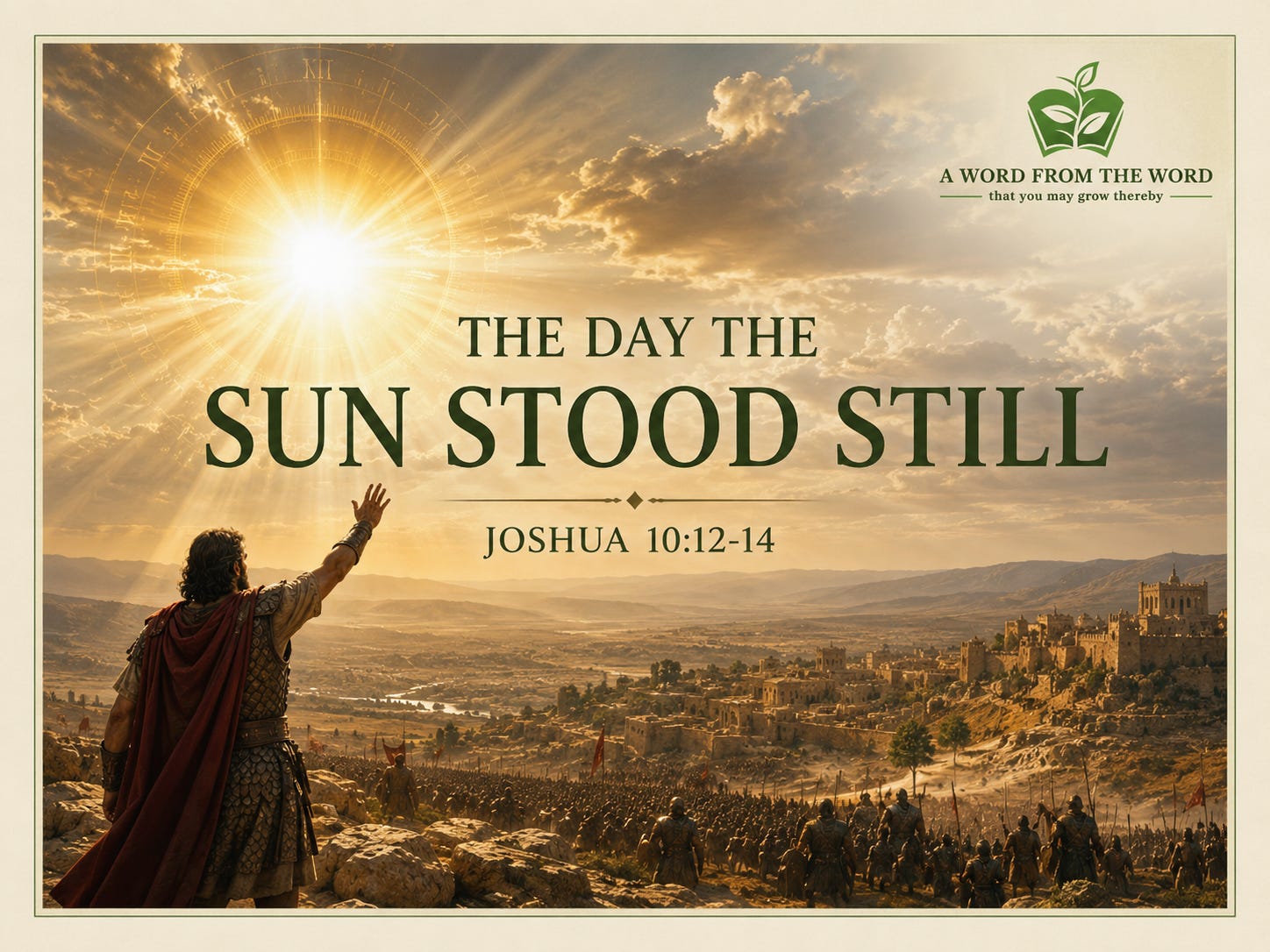
Suppose someone told you they had witnessed the longest day in human history.
Not because the earth’s rotation gradually slowed. Not because they traveled across time zones. But because the sun simply stopped moving across the sky.
You’d probably smile politely and assume they’re a few fries short of a Happy Meal.
That’s exactly why Joshua 10 has fascinated—and challenged—readers for centuries. The Bible says that in the middle of a battle the Israelites were winning, Joshua prayed for more daylight, and God answered. If that’s true, we’re looking at one of the most extraordinary miracles in all of Scripture.
So let’s slow down and examine what the Bible actually says.
What the Bible Says Happened
Joshua and the Israelites were fighting a coalition of Amorite kings. God had already promised Israel the victory, but daylight was disappearing. Joshua prayed: “Sun, stand still over Gibeon; and Moon, in the Valley of Aijalon.”
Then Scripture says: “So the sun stood still, and the moon stopped, till the people had revenge upon their enemies.”
The writer adds an astonishing observation: “There has been no day like that, before it or after it.”
The passage doesn’t read like poetry. It doesn’t suggest that the day merely felt longer. It describes an actual historical event in which daylight was supernaturally extended. That’s the claim.
Why This Seems Scientifically Implausible
Here’s the obvious difficulty. We know the sun doesn’t orbit the earth each day. The earth rotates, giving us the appearance of the sun moving across the sky.
If the earth suddenly stopped spinning, the consequences would be catastrophic. The atmosphere would continue moving at tremendous speed. Oceans would surge. Massive geological disruption would follow. Life as we know it could not survive such an event.
So when someone says, “That couldn’t happen,” they’re expressing a very understandable concern. The good news is that the Bible never tells us how God accomplished the miracle. It simply tells us that He did.
What God Actually Did
The text leaves the mechanism unexplained, and perhaps that’s intentional.
God could have accomplished Joshua’s long day in ways far beyond our present understanding. He may have altered the earth’s rotation while simultaneously preserving every physical system affected by it. He may have sustained the appearance of daylight by controlling the behavior of light itself. Or He may have performed another unique act that no human observer could fully describe.
The point isn’t that we can reconstruct the miracle scientifically. The point is that the Creator is not limited by the universe He created.
Think of an airline pilot. Most of the time, sophisticated computers (called “autopilot”) control the aircraft. But when the pilot takes the controls, the airplane doesn’t malfunction. It simply responds to someone with greater authority over the system.
Natural laws are like nature’s “autopilot.” They are wonderfully consistent because God designed them that way. But they are not the boss of Him. They are His servants.
Joshua’s miracle reminds us that the God who established the laws of nature is also free to act beyond them whenever His purposes require.
Why Believing This Is Reasonable
Some people hear this account and immediately conclude that belief requires abandoning science. I don’t think that’s true. Science tells us how the universe “normally” operates. Joshua 10 describes one moment when the Creator of nature’s laws personally intervened and switched off the autopilot.
Those are two very different categories.
The real question is not whether the universe can do this by itself. It cannot. The question is whether the God who created time, gravity, light, and the motions of the heavens has authority over them. If He does, then extending one day is no more difficult than creating the universe in the first place.
The difficulty of any task is measured by the One doing the work.
Once we acknowledge an omnipotent Creator, Joshua’s long day is no longer irrational. It becomes exactly the kind of event we would expect if God chose to answer a remarkable prayer.
What This Miracle Reveals About God
Joshua 10 isn’t primarily about astronomy. It’s about God’s sovereignty.
Time is one of the great limitations of human life. We never seem to have enough of it. Deadlines arrive. Opportunities disappear. Days come and go whether we’re ready or not. But God does not live under those limitations. He created time. He rules over time. He accomplishes His purposes in time. Nothing catches Him by surprise, and nothing forces Him to hurry.
This miracle also reminds us that God hears the prayers of His people.
Joshua wasn’t trying to impress anyone. He simply asked God to accomplish what only God could do. And God answered.
The miracle wasn’t intended to amaze Israel with a cosmic display. It was intended to demonstrate that the Lord was fighting for and with His people. Ultimately, that’s the greatest lesson of Joshua 10.
The God who rules the universe is not distant from His people. He is actively working on their behalf.
Closing Thought
Whenever I read Joshua’s long day, I’m reminded that the greatest miracle isn’t that the sun appeared to stand still. It’s that the Creator of the universe listened to the prayer of one man.
That tells me something remarkable about God. He is infinitely powerful, yet personally attentive. He governs galaxies, yet hears individual voices.
You may still wonder exactly how this miracle happened. So do I. Scripture doesn’t satisfy our curiosity about the mechanics. Instead, it directs our attention to the One who performed it. And perhaps that’s exactly where our attention belongs.
The greatest truth in Joshua 10 isn’t that God can interrupt the normal course of nature—He can!
It’s that nothing—not even time itself—can prevent Him from accomplishing His perfect will.